



AI in SEO works on two levels. Search engines use AI and machine learning to understand what a query means, and Google now answers many searches with AI Overviews and AI Mode, so your pages compete to be cited as well as ranked. SEO teams also use AI tools for keyword research, content briefs and data analysis, but human judgement still decides the strategy.
Search engines are where most people start when they need information, and AI now shapes both how they rank pages and how they present answers.
The world of search engine optimization (SEO) is undergoing a quiet revolution that is being fuelled by artificial intelligence (AI) and machine learning (ML) algorithms.
Artificial intelligence (AI) and machine learning (ML) have emerged as game-changers for SEO experts and businesses in this rapidly developing market. In addition to helping search engines provide more tailored results, these innovations equip SEO specialists with the tools they need to fine-tune their methods with pinpoint accuracy.
This article will delve further into the exciting realm of artificial intelligence and machine learning, and how these technologies are changing SEO strategies. We will look at what these technologies can do, how Google uses them and where they fall short.
Put on your seatbelts, because we’re about to go on an adventure that will reveal how AI can improve your SEO.
Key takeaways
- Google has used AI systems such as RankBrain, neural matching and BERT to understand searches for years.
- Since May 2024, Google's AI Overviews summarise many results, so pages now compete to be cited as well as ranked.
- AI tools speed up keyword research, content briefs and data analysis, but people still set strategy and check facts.
- Google treats mass-produced, low-value pages as scaled content abuse, whether AI or people made them.
- Answer-first sections, clear sources and real expertise make content easier for AI features to quote.
What Is AI?

The goal of Artificial Intelligence (AI) research is to develop machines that can do tasks normally associated with human intelligence. It’s the same as if we could train computers to mimic human thought and learning. I mean, how awesome is that?
Scientists and engineers in the field of artificial intelligence (AI) are always working to improve algorithms and models that give computers the ability to see and understand their environment, make decisions, and even learn from their past mistakes.
But AI isn’t just limited to chatbots. It’s used in various other fields such as the automobile industry, the healthcare industry, etc.
What Is AI Made Of?
Artificial intelligence is like a massive puzzle made up of many interesting components. Come on, let’s plunge in and find out what this is about!
i) Machine Learning: Machine learning (ML) is the foundation of artificial intelligence. The goal is to train computers to analyse large amounts of data and act on the basis of their findings, whether in the form of predictions or choices.
It’s the same as endowing them with a super brain, able to absorb vast amounts of data and improve their intelligence over time. Applications of ML range from recommendation systems (like Netflix’s) to the detection of credit card fraud.
ii) Natural Language Processing: This is all about enabling machines to interpret and respond to human speech. You have probably used NLP when interacting with digital assistants like Siri, Alexa, or Google Assistant.
These sophisticated AIs are able to interpret spoken orders and provide almost human-like responses. Other applications of NLP include translation between languages and sentiment analysis (determining whether a tweet is favourable or negative).
iii) Computer Vision: Another exciting facet of artificial intelligence is computer vision. The goal is to endow computers with the same visual and cognitive abilities as humans. Do you know about those photo-recognition apps? There you go; that’s the power of AI at work! Self-driving cars utilise it to “see” the road and security systems use it to spot potential threats.
iv) Expert Systems: These are essentially computerised versions of human experts in a given field. They are programmed to act as though they possess the same level of expertise as human beings. Therefore, an expert system can supply you with extremely astute suggestions in fields such as medicine and finance.
v) Robotics: Intelligent robots that can learn from their experiences and interact with their surroundings are currently in development. Robots are becoming increasingly useful companions in many settings, from assisting in surgery to exploring unknown places.
How Are AI and Machine Learning Changing SEO?
Artificial intelligence (AI) and machine learning (ML) have emerged as potent forces that are transforming the field of search engine optimisation (SEO). Prepare to be amazed by the ways in which AI and ML are changing search engine optimisation.
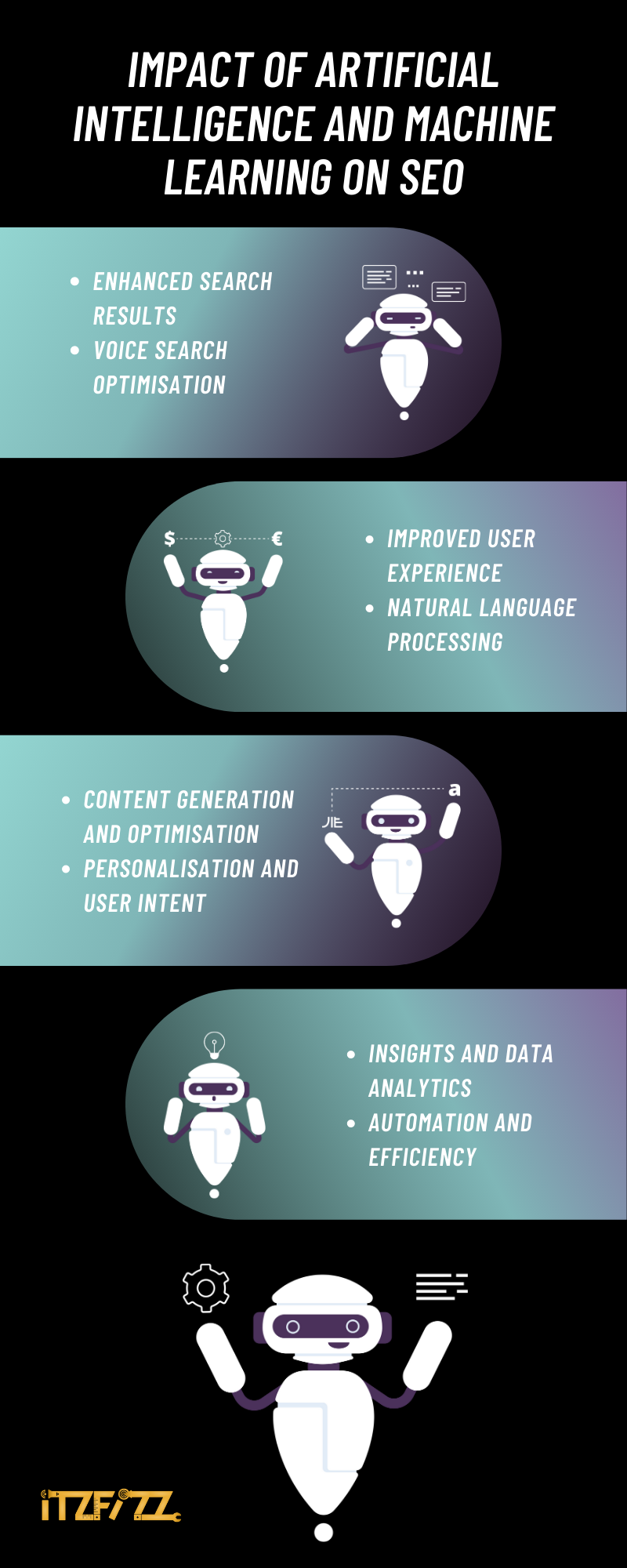
i) Voice Search Optimisation: Voice Search has gained popularity alongside the proliferation of virtual assistants like Siri and Alexa. SEO is evolving as AI-powered speech recognition lets search engines interpret and respond to spoken queries. To achieve high rankings, it’s essential to incorporate voice search optimisation.
ii) Improved User Experience: AI and ML tools can analyse engagement data such as click-through rates and time on page to show where a website frustrates visitors, so you can fix the user experience.
SEO experts are being encouraged to concentrate on developing content that’s both user-friendly and intriguing because search engines now give preference to websites that deliver a better user experience.
iii) Natural Language Processing: Natural language processing (NLP) makes it much easier for search engines to understand the intent and context of a query. Algorithms driven by AI are better at reading context, making sense of user queries and returning relevant results.
iv) Content Generation and Optimisation: AI and ML-based tools can generate content, automate content curation and optimise that material for search engines. They can sift through mountains of information to spot patterns and suggest how to shape content that readers will find useful.
v) Personalisation and User Intent: AI algorithms can examine user information, search history, and preferences. SEO specialists can use these insights to meet users’ needs and deliver more relevant, engaging content.
vi) Data Analytics: AI and ML can dissect massive datasets. SEO Professionals can use these features to learn further about user behaviour , keyword patterns, and website analytics. Using this data-driven approach, you can make better decisions and sharpen your SEO tactics.
How Does Google Use AI in Search Today?
Google has used machine learning to understand searches for years, and since 2024 generative AI sits on top of many results pages. These are the systems that matter most for SEO:
| Google AI system | What it does | What it means for your content |
|---|---|---|
| RankBrain | Helps Google understand how words relate to concepts | You can rank for queries that do not use your exact wording, so write naturally |
| Neural matching | Matches the concepts in a query to the concepts on a page | Cover the topic fully instead of repeating one phrase |
| BERT | Understands how combinations of words express meaning and intent | Word order and small words change meaning, so answer the exact question asked |
| MUM | Understands and generates language, used for specific tasks and not for general ranking | No direct action needed |
| AI Overviews (US launch May 2024) | AI-generated summaries with source links at the top of some results | Clear, answer-first passages are easier to cite |
| AI Mode (all US users from May 2025) | A conversational search mode for longer, more complex questions | Pages that answer follow-up questions in their own sections fit these longer journeys |
Sources: Google’s guide to its ranking systems, the AI Overviews launch post and the Google I/O 2025 announcements.
So what should you do differently? Four things:
- Write for meaning, not exact-match keywords, and answer the related questions people ask.
- Open every section with a direct answer that makes sense on its own, so AI features can quote it.
- Do not mass-produce AI pages. Google’s spam policies treat many low-value pages made to manipulate rankings as scaled content abuse, however they are produced.
- Track how you appear in AI answers as well as in rankings, and make sure crawlers can reach your pages. Our guide to how search engines work covers crawling and indexing.
How Is AI Changing the Role of SEO Professionals?
Artificial intelligence is causing major upheaval in SEO, significantly altering the work of SEO specialists. What does artificial intelligence (AI) mean for SEO professionals? Let’s find out.
Shifting Focus: SEO experts now have more time for strategy because AI-powered tools and SEO automation tools can handle routine work such as keyword exploration, data analysis and content optimisation.
Data-Driven Decision Making: SEO specialists now get sharper insights and data-driven recommendations from AI tools. Because AI can process huge quantities of data, SEO professionals can make better-informed decisions based on the patterns and trends it uncovers.
Collaborations with AI: Rather than seeing artificial intelligence( AI) as competition, SEO experts can work with it as a resource. Experts can be used to guide and confirm AI- generated suggestions as they work in tandem with AI- powered technologies.
Skill Development: As AI advances, SEO experts will need to constantly learn new techniques to adapt to the changing landscape. In order to maintain relevance and have a significant influence in the ever- evolving SEO field, they will have to commit to lifelong learning, probe AI developments, and acquire new capacities.
User Experience Optimisation: SEO experts can now spend more time on user experience, because AI can reveal users’ habits and preferences. Together, they can improve a website’s usability, mobile responsiveness and overall experience.
Emerging Trends Caused By AI
Here are some upcoming trends brought about by AI:
Personalised Experiences: Businesses can now cater to customers’ specific tastes and preferences by using AI.
Automation of Tasks: By taking over mundane jobs, AI allows humans to concentrate on further intricate and imaginative work.
Chatbots and Virtual Assistants: More and more businesses are turning to chatbots and virtual assistants to give prompt and effective service to their clientele.
Enhanced Data Analytics: AI allows sophisticated data analysis, which in turn helps organisations make well-informed decisions.
Voice Search and Voice Assistants: AI-powered voice assistants like Siri and Alexa are altering the way we use technology and conduct online searches with our voices.
Autonomous Vehicles: AI-powered self-driving cars aim to make commuting easier and safer.
Improved Healthcare: Medical imaging analysis, drug discovery, and individualised remedy suggestions are some examples of how AI is improving healthcare.
Smart Home: Smart speakers and thermostats are two examples of AI- powered smart home products that are revolutionising the way we interact with our homes.
Cybersecurity and Fraud Detection: AI helps detect cyber threats by examining large datasets and identifying fraudulent patterns.
AI in Education: Intelligent training systems and adaptable learning platforms are some examples of how AI is being used in the classroom.
How Has ChatGPT Changed SEO?
ChatGPT has been one of the most talked-about tools in marketing since OpenAI released it on November 30, 2022. People use it for everything from writing poetry to editing documents, and it is not confined to creative work.
It has also been making a huge impact in the field of Search Engine Optimisation. It is now a search engine too: since October 2024 ChatGPT can search the web and cite its sources, so brands compete to be named in its answers as well as in Google’s results.
ChatGPT is an AI chatbot created by OpenAI and built on large language models. It uses state-of-the-art NLP and ML methods to comprehend and create authentic sounding content.
ChatGPT’s sophisticated natural language processing and machine learning capabilities have altered the ways in which SEO experts go about their work. It streamlines the process of coming up with content by offering suggestions, topic ideas, and even drafting sections of the material itself. It can also help rewrite content in the conversational, question-and-answer style that suits voice search.
It can also review a page’s structure, menus or copy and suggest usability improvements, although it cannot see how your real visitors behave.
It helps with complex SEO activities including keyword research, data analysis, and routine automation. ChatGPT helps search engine optimization (SEO) experts hone their techniques, adjust to algorithm modifications, and provide people with material they actually care about, all of which raises search engine rankings and increases organic traffic.
Which SEO Tools Use AI and Machine Learning?
SEMrush: SEMrush is an SEO platform that uses AI to do a wide range of tasks. It has advanced features like researching keywords, analysing the competition, and optimising content. Its AI- powered suggestions can be used to boost search engine results and attract further customers.
BrightEdge: BrightEdge uses artificial intelligence to offer complete SEO packages. It has tools for finding keywords, perfecting content, and analysing the competition. You can enhance your website’s visibility and performance with the help of BrightEdge.
Frase: Frase is an artificial intelligence- powered content optimisation tool that facilitates the production of in- depth, SEO-friendly articles. It examines high- quality, high- ranking pages, finds areas where information is missing, and suggests ways to fill those gaps.
Google Search Console: Google Search Console is Google’s free tool for monitoring how your site performs in Search, and its query and page data is the raw material for most AI-driven SEO analysis. It provides data on indexing and search performance as well as analytics.
Linkio: Linkio began as a tool for automating link building and anchor text planning and now works mainly as a managed link building service, with an anchor text optimiser still on offer. SEO experts can use this to increase the effectiveness of their link- structure initiatives.
CHATGPT: ChatGPT is a useful SEO tool as well as a chatbot, and our guide to using ChatGPT for SEO shows the prompts that work. It is useful for content production because of its sophisticated natural language processing abilities, which enable it to produce interesting and optimised content.
Additionally, it helps with data analysis, keyword research, and SEO process automation, saving time and enhancing productivity.
What Are the Risks of AI and Machine Learning?
While AI and ML have the ability to bring about amazing improvements, it is also crucial to be aware of the dangers that they may pose. Here are a few risks we need to be aware of:
Discrimination and bias: The quality of an AI system depends on the quality of the data it was developed with. If the training data contained biases then the AI system would automatically reflect those biases. This can lead to unfair outcomes, such as favouritism in recruiting or in other decisions.
Lack of transparency: AI and ML algorithms can be hard to understand because they rarely show how they reach a result. This lack of transparency raises questions about accountability.
Data Privacy and Security: A major concern for people and businesses using AI is the possibility of a data breach or other forms of unauthorised access to sensitive information. Data privacy and security are crucial for digital success.
Loss of Jobs: The job market will be affected as AI and automation technologies continue to develop. The impact can be lessened by adapting early and making the transition as smooth as possible.
Overreliance and Loss of Skills: Overuse of AI and ML systems can weaken people’s ability to apply their own knowledge. People may stop questioning the answers algorithms give them if we rely on AI alone for decision-making.
Legal Challenges: In numerous cases, the development of legislation and laws lags behind the rapid-fire progress of AI technology. This raises questions about who should be held responsible, how to protect user rights, etc.
Conclusion
Businesses are always looking for new ways to strengthen their position in search. The impact of AI and ML on SEO keeps growing as these technologies shape both Google’s search algorithms and the tools SEO teams use every day. While SEO’s precise future is unclear, one thing is certain AI will continue to play a significant part in determining its development.
Companies need to understand what AI and ML can do if they want to stay visible in search. These technologies can greatly improve search engine optimisation (SEO). Companies can improve their data- driven decision making, search engine optimisation, and user experience by using AI’s skills.
Used with care, AI and ML can uncover new opportunities and better outcomes. If you want help building them into your strategy, talk to our SEO services team.