



To use ChatGPT for SEO, treat it as a fast assistant for research and drafting: brainstorm keyword ideas, outline content, write first drafts of title tags and meta descriptions, generate schema markup and summarise exported data. Then check every output against real search data and your own expertise, because ChatGPT can be confidently wrong and does not give reliable keyword volumes.
OpenAI released ChatGPT in November 2022, and this AI chatbot quickly became part of many marketers’ daily work. Since October 2024 it can also search the web and link to its sources, so it is now both an SEO tool and a place where people discover websites.
You might be wondering if this software has more uses than just editing documents and answering questions. Yes! Whether you believe it or not, ChatGPT can help in your SEO efforts. ChatGPT’s powerful natural language processing features make it easier to write engaging content, optimise keywords, and examine data, among other things. It’s like having an in-house SEO specialist available whenever you need one.
In this blog, we’ll learn all about ChatGPT and see how it can boost your search engine optimisation efforts. We’ll show you how to maximize the impact of this cutting-edge AI tool to boost your website’s visibility and attract more targeted visitors. Let’s dive right in!
Key takeaways
- ChatGPT speeds up SEO research and drafting, but every output needs checking against real data.
- It does not give reliable search volumes or keyword difficulty, so confirm keywords in a keyword tool or Search Console.
- Detailed prompts that state the audience, topic, goal and tone produce far more useful SEO suggestions.
- Google does not penalise content for being AI-assisted, but mass-produced pages that add no value can break its spam policies.
- To appear in ChatGPT search, your robots.txt must allow OpenAI's OAI-SearchBot crawler.
- Google AI Overviews and AI Mode need no special markup: an indexed page that can show a snippet is eligible.
What Is ChatGPT?
ChatGPT is an AI chatbot from OpenAI that answers questions, writes and edits text, and can search the web, all through a normal conversation. It’s a sophisticated language model that can mimic human speech and hold natural conversations with its human users.
It can function as a personal assistant, research subject areas, complete duties, and even write creative pieces. What really sets ChatGPT apart, though, is its astounding level of natural language understanding and response. It can have natural conversations with you, respond to queries and suggestions, and produce answers that make sense and are pertinent to the topic at hand.
It has many potential uses, from assisting customers and making new material to translating languages and teaching. Its adaptability and flexibility make it a vital resource in today’s interconnected world.
Benefits of ChatGPT
Ever wished you had a virtual assistant who could answer all your queries? ChatGPT is here to make your dream come true. Let’s dive into how ChatGPT is beneficial to all its users:
i) Instant Access to Information: You no longer need to waste time searching or sifting through various resources; ChatGPT has you covered. You can get detailed explanations for your inquiries on a wide variety of subjects.
ii) Natural Language Processing: One of the most fascinating features of ChatGPT is its capacity to comprehend and respond to real language. You can talk to it like you would to a real person, without having to learn any special phrases or lingo. It’s like having a conversation with an intelligent and kind pal.
iii) Personalised Assistance: ChatGPT caters to your individual requirements by learning about your habits and routines. It adapts to your tastes and preferences as you interact with it through conversations.
iv) Creative Writing Support: Do you create material or write? ChatGPT is a great tool to have at your side. It has the potential to spark new ideas,overcome writers block, etc. It’s like working with a collaborator who always offers new ideas.
v) Time and Cost Efficiency: ChatGPT helps you save time and money by automating routine tasks. You can get answers and help right away without having to conduct significant research or hire extra support workers.
These are but a handful of the numerous advantages of using ChatGPT. It’s an effective resource that improves your access to data, makes communication easier, and provides you with new opportunities. Try ChatGPT out for yourself and see what all the fuss is about.
What Is ChatGPT for SEO?
ChatGPT for SEO means using OpenAI’s chatbot to speed up search engine optimisation tasks such as keyword ideas, content outlines, meta tags, schema markup and data analysis. It does not replace SEO tools or expertise, but it removes a lot of blank page work.
ChatGPT uses its NLP skills to investigate and comprehend SEO’s complexity. It can help with research, keyword suggestions, and writing engaging content that will do well with both search engines and human readers. ChatGPT can also help you analyse data, investigate the competition, and find fresh ways to boost your website’s performance.

What Are the Benefits of Using ChatGPT for SEO?
Do you want to take your SEO to the next level by tapping into the power of AI? Get ready to be amazed by the amazing advantages of adopting ChatGPT for search engine optimisation (SEO).
i) Accelerated Keyword Research: No more spending hours upon hours thinking about keywords for your article. Forget about spending hours thinking of relevant terms. You can rely on ChatGPT to streamline your work.
It can help you discover effective keywords that correspond to the queries of your intended audience. Using ChatGPT, you can find the unheralded jewels that can catapult your search engine ranks and bring in more natural visitors.
ii) Effortless Content Generation: In search of some fresh ideas for your next online article? ChatGPT is the perfect tool for brainstorming! It can inspire new topics to write about, offer guidance on how to organise your material, and even recommend catchy titles.
iii) Easy On-Page Optimisation: Search engine optimisation (SEO) is a process that sometimes feels overwhelming. But no worries, ChatGPT can provide helpful suggestions for improving things like meta tags, headers, and internal links. By adhering to ChatGPT’s recommendations, your site will be perfectly optimised, sending a strong message of relevance to search engines.
iv) SEO Data Analysis Made Simple: ChatGPT can help you make sense of the numbers and draw conclusions. Data-driven decisions can be made about your SEO strategy, and it can help you notice patterns, seize opportunities, and more. Your website’s performance and areas for improvement will become more apparent with ChatGPT as your analytical partner.
v) Instant Solutions to Your SEO Questions: Want answers to your pressing queries regarding search engine optimisation and the most recent algorithm changes? Just ask ChatGPT. Treat its answers as a starting point and confirm anything about Google updates in official sources, because the model’s knowledge can be out of date.
vi) Improved Competitor Analysis: In the SEO world, one must always be one step ahead of the competition. Analysing your competition’s tactics, backlink profile, and content strategy is a breeze with the help of ChatGPT. You’ll be able to get ahead of the pack and shine brighter than the competition with the knowledge you receive from this.
vii) Continuous Learning and Improvement: With memory turned on, ChatGPT can remember details you share, such as your brand voice or target market, and use them in later chats.
How Do You Use ChatGPT for SEO?
Using ChatGPT for SEO allows you to make use of AI to boost your website’s visibility in search engines. Follow this detailed guide to optimise your website with ChatGPT:
Keyword Research
You can use ChatGPT to conduct keyword research for your content. In order to acquire useful feedback, you need to specify your audience, field, and topic of interest. You can acquire a list of possible keywords to use in your SEO strategy from ChatGPT, and prompt libraries such as AIPRM for ChatGPT offer ready-made SEO prompts.
Long-tail keywords, related terms, and even niche-specific keywords that you would not have thought of on your own can all be generated via ChatGPT. It cannot give you reliable search volumes or keyword difficulty, so check those numbers in a keyword tool or Google Search Console before you commit.
You can increase your website’s organic traffic and rank higher in search engine results by using the features of ChatGPT to find lucrative keywords.
Prompts for Keyword Research
- Generate X keywords for “Seed Keyword”
- Find X Long-tail keywords for “Seed Keyword”
- List LSI keywords for “Seed Keyword”
- Generate a list of questions on “Seed Keyword”
- Find keyword ideas from the following text “Content”
Source: Meetanshi

Meta titles and Descriptions
If you’re having trouble coming up with catchy names and descriptions for your web pages, ChatGPT can help a great deal. You can ask ChatGPT for help to come up with catchy titles that do justice to the content of your pages by striking up a conversation with it.
ChatGPT can come up with innovative recommendations and variations when you tell it the goal, keywords, and tone you’re going for. ChatGPT can also help you build compelling meta descriptions to accompany your search engine results.
Prompts for Meta titles and Descriptions
- Create [X] distinct title tags with a maximum of 60 characters for the text below. They must be descriptive and contain the word “keyword”
- Provide catchy blog post titles relating to the list of SEO keywords below
- Make the blog article’s title, [title], more appealing.
Source: Popupsmart

Content Ideation
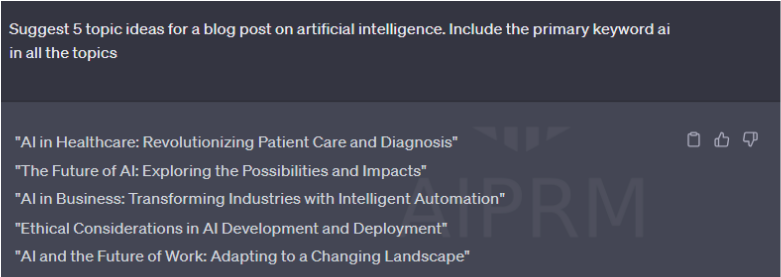
Talk to ChatGPT when you’re at a loss for what to write about. Outline the subject you want to write about, your intended readers, and your desired outcome.
In order to make your content more engaging for both readers and search engines, ChatGPT can help you come up with new ideas, sketch out possible structures, and even come up with memorable headlines.
Prompts for Content Generation
- Suggest [X] topic ideas for a blog post on [subject]. Include the primary keyword [X] in all the topics
- Generate a blog post outline on the topic [X]. The outline must have [Y number of] subheadings
- Write an FAQ section for a blog post on [Topic], along with the answers
- Rewrite this paragraph in simpler terms
- Generate [X] captions for an Instagram post on the topic [topic]. Craft the captions for [target audience] and keep a [specify tone] tone. Include quotes and any other elements to make it more interesting
Source: Narrato
Generate Schema Markup
To help search engines better comprehend and display your material in search results, you can use a structured data format called Schema markup. You can generate schema markup for your websites with the help of ChatGPT, then test it before it goes live as part of your technical SEO checks.
ChatGPT allows you to explain the material you want to mark up, such as articles, events, items, or reviews, and receive advice on the best schema markup to employ during your chat.
Prompt for Generating Schema Markup
Generate schema markup for the following question and answer

Analysing SEO Data
You can analyse your SEO statistics using ChatGPT by providing it with information about your website’s traffic, keywords, and rankings. Request explanations and interpretations to help you spot trends, zero in on problem areas, and zero in on optimisation opportunities. If you want to improve your SEO efforts, ChatGPT can help you do it a data-driven way.

Competition Analysis
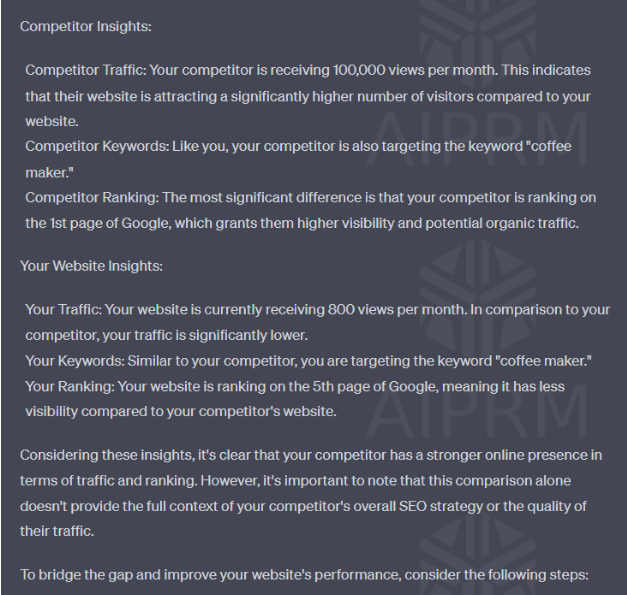
If you need help analysing your competition’s website, backlinks, and content tactics, you can turn to ChatGPT for assistance. You can learn from their mistakes and improve your own strategies by inquiring about their successes. Learning about the strategies used by other businesses allows you to improve your own search engine optimisation (SEO) tactics.
User Experience Optimisation
Improve your website’s engagement and conversion rates by talking to ChatGPT about user experience (UX) optimisation. You can get some expert opinion on how to improve the user experience, particularly on mobile devices by asking ChatGPT.

You can increase your website’s exposure, organic traffic, and ranks by using ChatGPT to supercharge your SEO efforts.
What Are the Drawbacks of Using ChatGPT for SEO?
Although ChatGPT has the potential to be a useful SEO tool, it is essential to be aware of any risks involved. Some things to keep in mind are as follows.
Lack of domain expertise: ChatGPT’s replies are informed by the assumptions it has made from massive volumes of text data. The lack of domain-specific knowledge or industry expertise, however, may result in less accurate or relevant information in some situations. ChatGPT’s recommendations should be carefully considered and checked against other credible sources.
Inconsistency and occasional errors: ChatGPT’s responses can be hit-or-miss in terms of quality and accuracy. It can also state wrong information with confidence, and Google’s guidance on generative AI content asks publishers to check AI output for accuracy before it goes live. Before incorporating any suggestions made by ChatGPT into your SEO strategy, it is essential that you conduct additional research to confirm their accuracy.
Dependency on input quality: ChatGPT’s performance is highly dependent on the accuracy and detail of the user’s input. The generated responses can fall short of expectations if the initial prompt or instructions were ambiguous.
Ethical considerations: Avoid pasting confidential client data or private analytics into ChatGPT unless your plan and data controls allow it. Although efforts have been taken to reduce the likelihood of biased results, it is still possible for it to generate unsuitable or biased results by accident.
Although these limitations exist, ChatGPT still has potential as a useful resource provided the generated suggestions are carefully evaluated. It can help your SEO by giving you fresh ideas and viewpoints, but you should always rely on human judgement and experience when making important SEO decisions.
How Do You Get Cited by ChatGPT Search and Google AI Overviews?
ChatGPT is no longer only a writing tool. It can now search the web and link to its sources, and Google answers many queries with AI Overviews and AI Mode. The work that earns citations in these answers is careful, ordinary SEO, plus making sure the right crawlers can reach your pages.
| AI search surface | What decides if your page can appear | What to do |
|---|---|---|
| ChatGPT search | OpenAI’s OAI-SearchBot crawler must be allowed to read your site | Check that robots.txt allows OAI-SearchBot. Blocking GPTBot only opts you out of model training, not search (OpenAI crawler documentation) |
| Google AI Overviews and AI Mode | The page must be indexed and eligible to show a snippet in Google Search | No special schema or file is needed. Keep key content in text and make structured data match the visible page (Google on AI features) |
Once crawlers can reach you, AI assistants tend to quote passages that answer a question cleanly. These habits help:
- Open each section with a one or two sentence answer, then explain.
- Use question headings that match how people ask, and add a short FAQ.
- Back claims with named sources and specific numbers, and keep pages up to date.
- Put comparisons in tables, which are easy to extract.
- Get the basics right with an on-page SEO checklist.
You can use ChatGPT itself as a test bench. Ask it the questions your customers ask and note which sites it cites. If competitors appear and you do not, compare their pages with yours section by section. For a wider plan that covers both rankings and AI answers, see our SEO services.
Conclusion
Finally, you have it! Used carefully, ChatGPT saves hours on SEO research and drafting and frees you to focus on the work that actually moves rankings. The possibilities for improving your site and its content are practically limitless once you start using this new language approach.
ChatGPT can be a reliable partner in the area of SEO, helping you with everything from coming up with catchy meta titles and descriptions to coming up with new ideas for content.
Maintain a spirit of experimentation and adaptation as you work to incorporate ChatGPT into your SEO strategy. Search now happens in AI answers as well as in the classic results, so the habits that make ChatGPT useful, clear questions and checked facts, also make your own pages easier for AI assistants to cite. The best of luck with your optimisation efforts!